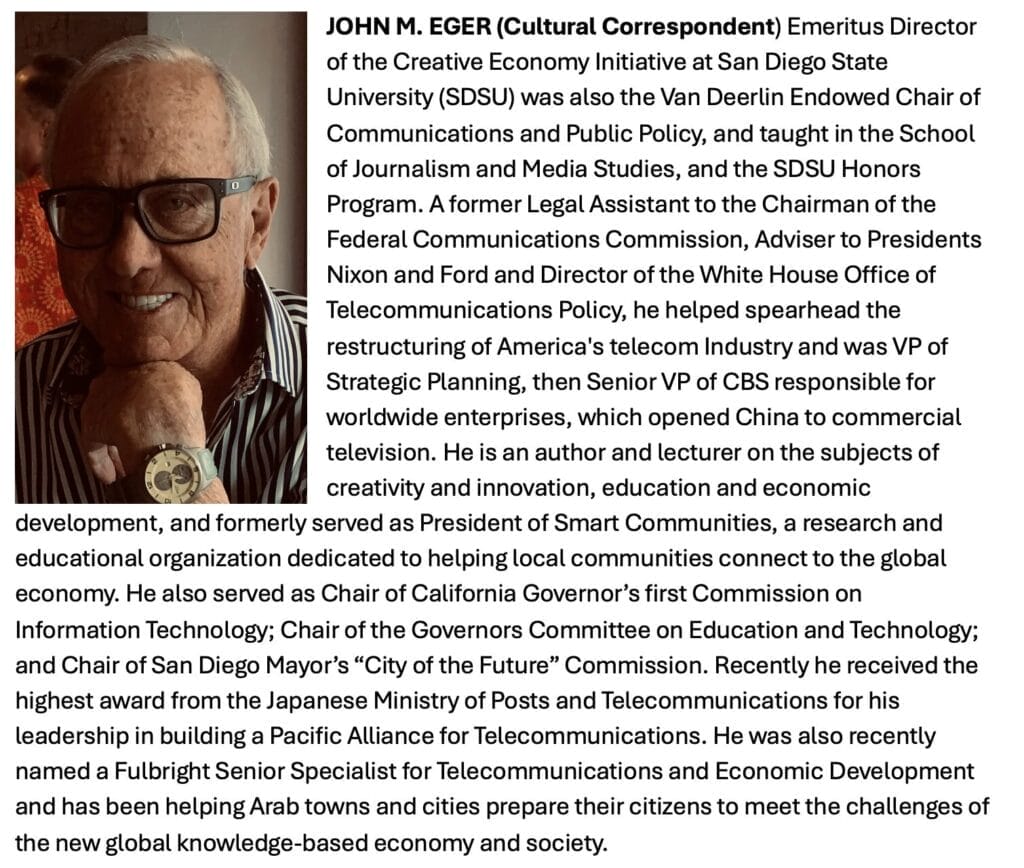

By John M. Eger
July 27, 2025

In a recent piece for The Wall Street Journal, writer Callum Borchers observed that “careers in the humanities, arts, or skilled trades might be safer bets for the next generation.”
It’s a startling claim in an era so dominated by technology. But he may be right—and many tech leaders seem to agree. Increasingly, Silicon Valley executives are enrolling their children in schools that prioritize creativity, empathy, and design thinking over memorization and STEM-heavy curricula.
So how did we get here?
For decades, degrees in engineering, computer science, and physics were seen as golden tickets to job security and prosperity. But that narrative is shifting. Between 2009 and 2022, the number of computer science degrees awarded in the U.S. nearly tripled, according to the National Center for Education Statistics. Yet, many of these graduates are entering a job market transformed by automation, artificial intelligence, and cloud computing—technologies that are rapidly rendering technical skills obsolete.
The foundational principles of math and science remain intellectually rigorous and deeply important. But their practical applications have a fast-diminishing shelf life. In some fields, the “half-life” of a skill—the time it takes for half of what you know to become irrelevant—is just three to five years. That means many students are saddled with six-figure debt, sometimes exceeding $200,000, only to find themselves needing to retrain before their student loans are even paid off.
Even university professors and industry leaders now acknowledge what was once taboo: while a technical degree might offer an early-career advantage, it no longer guarantees long-term relevance. Today’s job market rewards not just what you know, but how fast you can learn, adapt, and think across disciplines.
So, if left-brain logic and analytical skills are no longer sufficient, what is rising to take their place?
Surprisingly, the answer lies in the arts and humanities—fields once dismissed as “soft” or impractical. These disciplines foster creativity, emotional intelligence, communication, and the ability to make meaning—all distinctly human traits that machines struggle to replicate. As author Daniel Pink argues in A Whole New Mind, we are transitioning from the Information Age to the “Conceptual Age,” where creators, empathizers, and meaning-makers will thrive.
Pink identifies six essential aptitudes for the modern economy: Design, Story, Symphony, Empathy, Play, and Meaning. These aren’t luxuries—they’re survival skills in a world where information is cheap and change is constant.
Alternative education models like Montessori and Waldorf—which emphasize autonomy, curiosity, and collaboration—are gaining traction, not just in early childhood education but in adult learning and corporate training. A meta-analysis of 32 studies on Montessori education found that students outperformed peers in both academic performance and creativity. These approaches are being re-evaluated and integrated into training programs for today’s dynamic, innovation-driven economy.
This doesn’t mean we should abandon STEM. We still need engineers, data scientists, and physicists. But it’s becoming increasingly clear that adaptability—not narrow technical specialization—is the real currency of the future. While technical skills fade, imagination, empathy, and storytelling grow richer over time.
The more relevant question isn’t “What should I major in?” But “What will still matter when algorithms can do my job?” Machines can calculate, analyze, and optimize. But they can’t build community, imagine better futures, or create meaning. These remain inherently human capabilities.
And they are becoming increasingly critical. As automation grows across industries, especially in the wake of the COVID-19 pandemic, the need for creativity and human-centered thinking is more urgent than ever. Martin LaMonica, writing for The Conversation, noted how robots in hospitals were deployed to take temperatures, monitor patients, disinfect surfaces, and deliver meals—tasks once performed by human staff. These changes aren’t temporary. According to the World Health Organization, infectious diseases are emerging at unprecedented rates, driving continued demand for automated solutions in healthcare and beyond.
Meanwhile, analysts predict that a significant portion of current jobs—possibly most—could disappear within the next 20 years. This is why art and creative thinking are becoming essential—not just as cultural enrichment, but as economic survival strategies.
A Personal Reflection
For most of my professional life, I’ve wondered why we separate art and science—why we treat artists and scientists as fundamentally different kinds of people. This question became especially urgent when, as Chair of California’s Information Technology Commission under Governor Pete Wilson, I learned that Hollywood couldn’t find enough workers who were both artistically skilled and technologically fluent. Studios pushed for more H-1B visas to import talent from abroad, rather than investing in homegrown talent with hybrid capabilities.
This wasn’t a visa issue—it was a skills issue. American students simply weren’t being trained in ways that integrated both the analytical and the creative. We now understand that the most valuable workers in the 21st-century economy will be those who possess both STEM proficiency and creative fluency—those who can solve complex problems with both logic and imagination.
This is particularly urgent now that AI and robotics can do much of what humans once considered uniquely ours. Machines don’t take vacations, get sick, or ask for raises. But they also don’t imagine, inspire, or connect the dots in original ways.
THE ARTS ARE NO LONGER A LUXURY. THEY ARE CENTRAL TO PREPARING THE NEXT GENERATION TO THRIVE IN A WORLD WHERE AUTOMATION, GLOBAL PANDEMICS, AND ACCELERATING CHANGE ARE THE NORM.
In the end, the most valuable degree may not be the one that offers the highest starting salary, but the one that allows you to evolve, empathize, and create—skills that don’t expire and can’t be outsourced to machines.