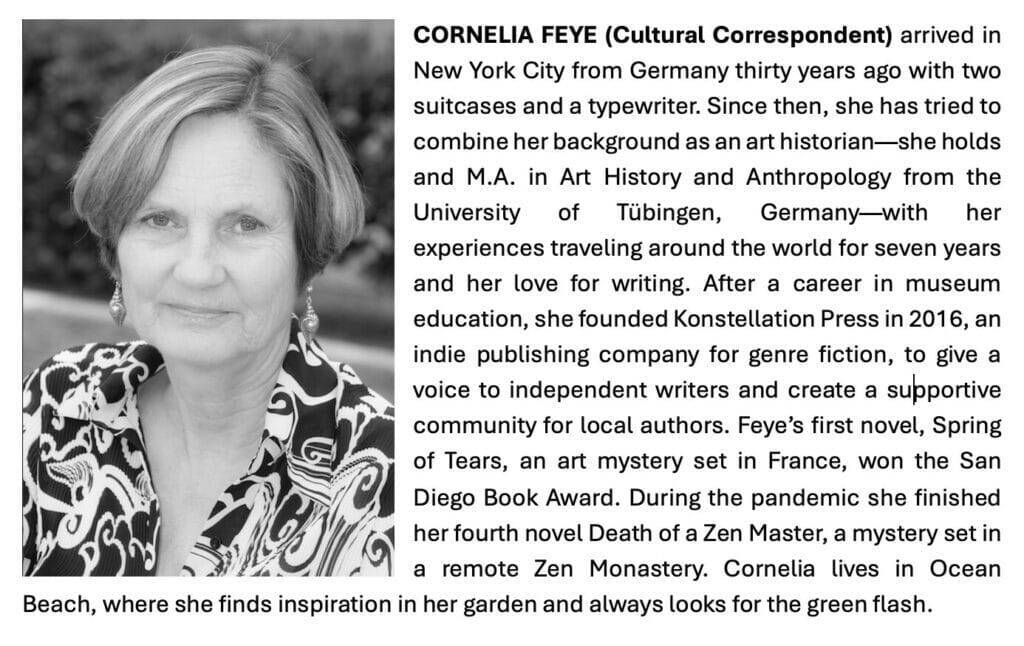

by Cornelia Feye
February 11, 2026
Space4Art and Art Produce have joined forces.
Situated in the Heart of North Park on University Avenue, Art Produce Gallery will be home to a year of exhibitions in collaboration with Space4Art, which provides affordable studio space for artists, but doesn’t own a traditional gallery space. Space4Art hired curator Katie Ruiz in October to line up programming for a year, and curate the inaugural exhibition Non-Objective Lessons. The cooperation is possible thanks to a substantial Prebys Foundation grant. Lynn Susholtz, founder of Art Produce was ready to retire, and was looking for someone to run the Gallery, so the two organizations partnered up. The timing was perfect.
When I asked Ruiz about her vision for the abstract art exhibition Non-Objective Lessons, one of several month-long exhibitions, each to be curated by different curators, she explained: “It took me a long time to figure out the San Diego abstract world, and I was kind of baffled by it, to be honest. I went to grad school in NYC and so I had a completely different experience of abstract art, I was looking at abstract expressionists.” Ruiz returned to San Diego in 2016 after finishing grad school and opened a small gallery in Little Italy, called Vivid Space. It only lasted one year, because Ruiz did everything herself and burned out quickly. Ruiz followed the work of Melissa Walter, Kaori Fukuyama, Andrew Alcasid and several other of the artists for years and the Non-Objective Lessons show was an opportunity to bring them together. Artists included are Melissa Walter, Xavier Dionne, Joey Thurston, Kaori Fukuyama, Jonny Hoolko, Jennifer de Poyen, May-ling Martinez, Lynn Susholtz, Andrew Alcasid, Meghan Augustine, Elijah Rubottom, Brennan Hubbell, Thomas DeMello, and Michael James Armstrong.
Ruiz continued, “I wanted to represent newer artists, and more established artists, and also two neurodivergent artists. Several of the artist have studio space at Space4Art, and I saw their work during open studio hours. I choose these artists to create the first Space4 Art and Art Produce exhibit as being very inclusive.” Ruiz wanted to highlight those artists as well as other local artists like Melissa Walter and Kaori Fukuyama, who are well-known and follow in the line of the San Diego abstraction movement but don’t have studios at Space4Art. The title of the exhibition is a play on words. Non-Objective can mean something subjective or ambivalent, or it can mean, not depicting any objects and therefore abstract.
Melissa Walter, one of the artists, joined the conversation and told me about her work.

“I’d gone to a residency in Oregon, called Playa, it was at very remote location, at the edge of a dried lake bed, which was the reason for the name La Playa or beach. I was researching techniques to calm the limbic system in order to assist folks who will be possibly going off planet and exploring other planets in the future.” When I expressed my surprise at this unusual perspective, Walter answered, “Yeah, my background, my side hustle is astrophysics.” She stayed at this very remote location with only five residents in her cohort, the first ones out of Covid. Exploring the land with the mindset of folks exploring new planets and territories fit well with the desolate surroundings and limited company. “I wanted to figure out how that would feel and how to colonize other planets, and if we should be doing it at all.”
She collected samples of the land, like she assumed interplanetary explorers would be doing, and then researched techniques to calm the limbic system. This probably would be helpful for astronauts stranded on another planet in a precarious living situation. What she came up with was the use of sound waves to create these images.
“You wouldn’t know it from looking at them, but I had small speakers and I played specific tones, really, really loud, and I held the paper with the pulverized material from the lake bed and surrounding areas in Oregon, above the speakers. The sound waves acted on the material and created accidentally shapes that are reminiscent of nebula and other phenomena that’s happening in the universe”. Once Walter explained it, I could see it, and found it a unique way to create art. I wasn’t sure about the calming effect of really loud sounds played on speakers, but I haven’t tried it out. “The residency lasted three weeks,” Walter added, “and I could have done maybe another week, but it was just too remote and isolated for a longer stay. We were siloed in our own cottages and cabins, first because of Covid and then to give everybody the space they needed to work, which worked for me, because I wanted to get into the headspace of isolation. The idea of connection with very few people, was the perfect environment for the research I was doing about off-planet living.” I admit, this was the first time I ever had considered off-planet living, and I appreciate Walter’s art taking the viewer to such an extraterrestrial space.
Next to Melissa Walter’s work hangs a sculpture by Kaori Fukuyama, an artists with a Japanese background and minimalist aesthetic.

The two-part white, relief sculpture looks like two slices of a elegant fruit set next to each other. It turns out to be another Covid 19 piece.
“I was toying around during the pandemic with the idea of being stuck at home with my husband,” Fukuyama said. “We were two people that fit together like this sculpture.” Sometimes they fit together well, sometimes not so well. Everybody who has lived through the pandemic with a partner stuck in a house together, can most likely relate to this statement. “This sculpture depicts a happy place, two individuals, two different people, supporting each other. I wanted to express this human relationship using forms during the pandemic.” Fukuyama explained that there is a second version of this sculpture, where the two pieces are not so harmonious, and don’t fit so seamlessly. What a beautiful way to express sometimes messy relationships in the form of an elegant sculpture.
A third example from the exhibition created by Art Produce founder Lynn Susholtz is entitled Anyforce

Anyforce is a Found Object of a repurposed industrial plumbing fixture, originally produced c. 1930s–1950. Presented as a wall-mounted sculpture, this piece functions as classic “ready-made” art. By following the lineage of Marcel Duchamp—isolating a mundane object from its utilitarian context—Susholtz transforms a mechanical tool into an object of mystery. Mounting Anyforce on the wall in a gallery context, Susholtz shifts the viewer’s focus away from its mechanical function and toward its formal qualities like the aggressive radial symmetry, the tactile industrial ribbing, and the switch or dial with the brand name Anyforce. With this object, Lynn Susholtz explores architectural memory and the social history of objects.
Anyforce sits at the intersection of Industrial Deco and Mid-Century Futurism. To a modern eye, the 16-inch diameter and translucent, light-catching textures suggest a UFO or a celestial body. The passage of time transformed this mundane tool into an object of mystery.
Originally the object was an industrial-scale adjustable shower hose manufactured by the Speakman Company and featured a signature handle or dial that allowed the user to mechanically adjust the water’s pressure and spray pattern. What appears at first to be a light switch is, in fact, the mechanical regulator. Rotating the Anyforce dial moved internal plungers to restrict or open the flow, a tactile interaction that Susholtz preserves to invite questions about control, force, and domestic history.
Ultimately, Non-Objective Lessons succeeds by proving that abstraction is never truly ‘non-objective’. Whether it is the rhythmic sound waves of a dried lake bed, the silent embrace of a shared domestic life, or the repurposed steel of an industrial relic, these works are deeply rooted in the human experience. They invite the viewer to look past the surface of the material and encounter an evolving conversation defined by curiosity and the freedom to see the world anew.
Non-Objective Lessons closes on Thursday, February 12, with an artist panel discussion and closing Reception from 6-8 pm at Art Produce, 3139 University Ave, in North Park.
The next exhibition will be organized by two artist curators from L.A, who run a space called Material Projects, Downtown LA. And the title of their show is The Material is the Message. It opens Sat. March 7, at 4-7, runs 4 weeks. Artist panel discussion, March 18 from 5:30-7:30PM