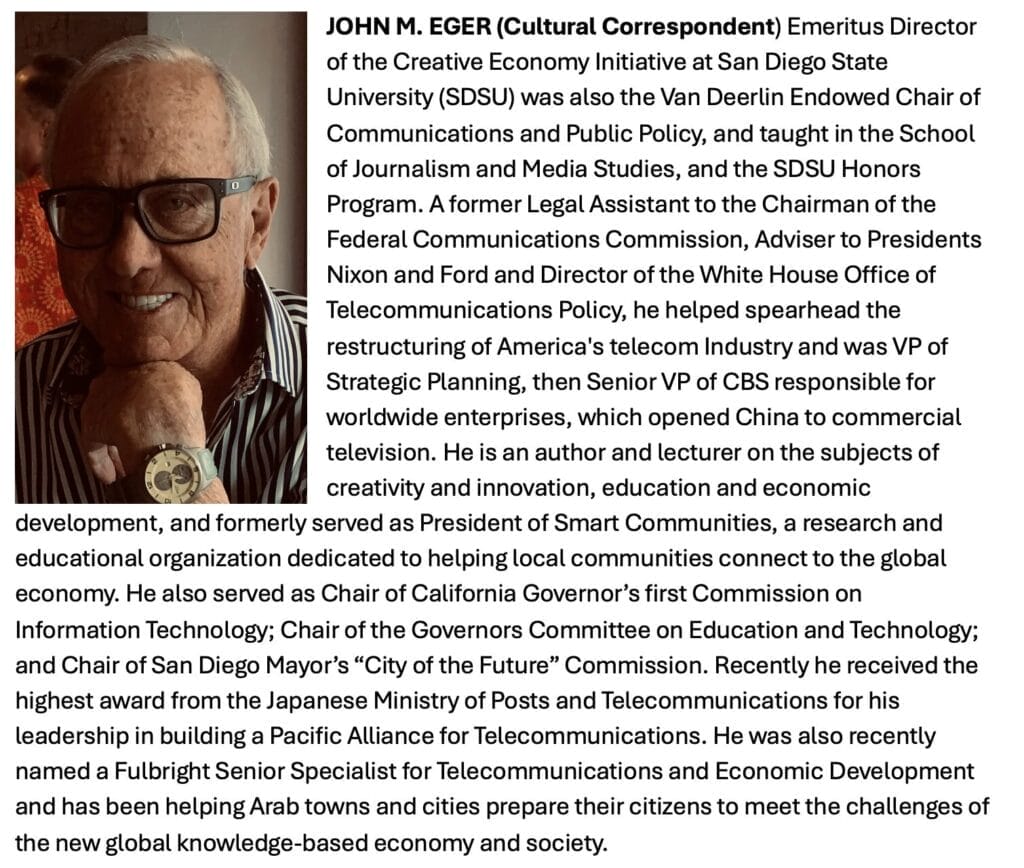

by John M. Eger
June 23, 2025

For decades, higher education—even in models where art and science are integrated—has been seen as the surest path to upward mobility. But that belief is increasingly being called into question.
Despite technological advances and seismic shifts in how we learn and work, most universities have failed to adapt their curricula to reflect the skills demanded by today’s evolving workforce. Employers are not just seeking credentialed graduates—they want individuals who are creative, collaborative, and innovative. These are precisely the qualities that rigid, outdated degree programs often fail to cultivate.
The traditional university model is becoming unsustainable in a world marked by skyrocketing tuition, crushing student debt, and a labor market where a college degree no longer guarantees job security or economic mobility. Compounding the problem is higher education’s persistent tendency to prioritize the sciences over the humanities, undermining the very skills that AI and automation cannot replicate.
Integrating Arts and Sciences: The Case for STEAM
A 2018 report from the National Academy of Sciences emphasized the importance of integrating the humanities and arts with STEMM fields (science, technology, engineering, mathematics, and medicine). The report concluded that such integration leads to positive learning outcomes that not only help students enter the workforce but also empower them to live enriched lives and become engaged, informed citizens.
While universities may not explicitly choose science over the humanities, there’s a clear trend toward prioritizing STEM disciplines—driven by perceived career prospects, societal pressures, and a narrow focus on technological advancement. However, the humanities remain essential for cultivating critical thinking, ethical reasoning, communication skills, and cultural awareness—attributes increasingly valued in all professional fields. Simply put: STEAM—science, technology, engineering, arts, and mathematics—must replace STEM as the dominant model for 21st-century education.
The Democratization of Knowledge and another Challenge to Education
At the same time, the internet has democratized access to education, offering high-quality instruction through online platforms, AI-powered learning tools, and alternative credentialing systems. These innovations are breaking down barriers and threatening the long-standing monopoly that universities have held on learning. As the costs of traditional education continue to rise, students are exploring faster, cheaper, and more personalized pathways to success.
The Political Undercurrent
Recent warnings from the Trump administration directed at institutions like Harvard are alarming—if not outright unconscionable. But the deeper, more existential threat to higher education goes well beyond partisan politics. It lies in the inability or unwillingness of universities to modernize, to respond to the needs of a world transformed by globalization, digitization, and now, artificial intelligence.
Too many institutions remain anchored in the past—favoring rote memorization over critical inquiry, rigid degree pathways over lifelong learning, and prestige over relevance. Unless universities undergo profound structural reform—and unless employers begin valuing adaptability, creativity, and real-world problem-solving over static credentials—many of these once-venerated institutions may not survive the next decade.
AI: The Most Disruptive Force Yet
Nowhere is the disruption more profound than in the rise of Artificial Intelligence (AI). Once the stuff of science fiction, AI is now transforming virtually every sector of the economy.
- In agriculture, AI enables precision farming that boosts yields and reduces environmental impact.
- In manufacturing, AI improves efficiency and cuts waste.
- In energy, it accelerates the transition to renewable resources.
- In healthcare, it is revolutionizing everything from:
- Early disease detection
- Personalized medicine
- Nanomedicine and bioprinting
- Predictive analytics and diagnostics
These breakthroughs promise extraordinary advances—but they also render many traditional educational paths obsolete. AI-driven platforms are already delivering elite-level education at a fraction of the cost of a four-year degree. Students can now bypass traditional institutions in favor of modular, self-directed, lifelong learning tailored to their interests and job market demands.
Technology alone will not fix what is broken. What’s needed is a wholesale reimagining of education—one that discards obsolete paradigms and builds a more inclusive, flexible, and resilient system grounded in both technology and human values.
A Generation at a Crossroads
Today’s young people face profound economic and existential uncertainty. Many are postponing or abandoning plans to start families—not out of apathy, but because of overwhelming costs, college debt, climate instability, and an absence of economic opportunity. They’ve inherited the failures of prior generations—but also the tools, technologies, and vision to build something better.
Despite the challenges, there is reason for optimism. We have the capacity to redefine the purpose of education, to ensure that it evolves alongside technology—not as its shadow, but as its moral compass.
To get there, universities must evolve. They must integrate the arts with the sciences, embrace lifelong and experiential learning, and align curricula with a world that rewards curiosity, empathy, and bold thinking.
The stakes are high. But so is the potential for renewal.