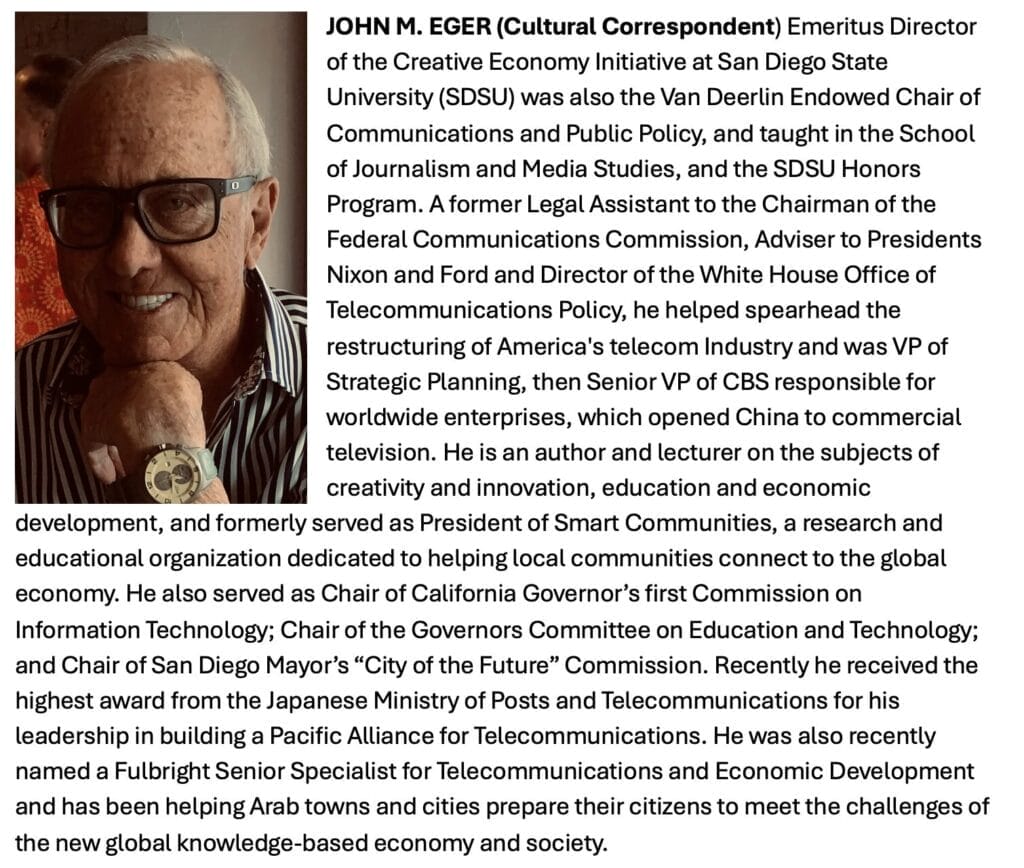

by John M. Eger
August 11, 2025

Young people are inheriting a fractured world.
They face the compounding burdens of systemic racism, climate change, pandemics, economic instability, white supremacy, poverty, and homelessness.
These overlapping crises widen the opportunity gap and threaten to extinguish the potential of an entire generation and, as a result, our young are asking courageous, necessary questions: Why maintain systems that no longer serve the many? Why inherit a broken world without rewriting its rules?
Their frustration is not nihilism; it is the fuel of innovation. Today’s youth are more connected, informed, and passionate than any generation before them. They are redefining success—not by wealth or status, but through creativity, justice, sustainability, and global impact.
Importantly, our greatest hope rests with the next generation. But that hope depends on our willingness to equip young people with the skills, opportunities, and freedom they need to transcend the outdated systems that continue to fail them. Keeping America strong, safe, and resilient will require reimagining education at every level, ensuring effective and ethical governance, and mobilizing every sector—corporations, nonprofits, and individuals—to build a future that is sustainable, inclusive, and just.
Despite the gravity of today’s challenges, hope endures.
Breakthroughs in medicine, artificial intelligence, and emerging technologies offer glimpses of extraordinary solutions—if we have the courage and imagination to act. At the heart of this progress lies a singular imperative: to empower young people to rebuild what has been broken and to create what has yet to be envisioned. To do so, education must become the catalyst for transformation. Today’s education system is falling short. Still dominated by rote memorization, standardized testing, and rigid hierarchies, it stifles creativity instead of nurturing it.
A complete transformation is long overdue.
We must move from passive instruction to active, engaging learning models that prioritize: (1) Creativity and innovation as foundational skills. (2) Hands-on, real-world experiences that teach adaptability and problem-solving, and (3) Ethical responsibility in the development and use of new technologies
The workforce of tomorrow will need to adapt to industries and challenges we can’t yet foresee. Success will require more than technical knowledge; it will demand empathy, cultural fluency, and moral clarity. We must also be willing to confront and explore bold—even uncomfortable—ideas, including brain-computer interfaces, AI-human collaboration, and other radical technologies. These concepts are not science fiction. They are tools that, if guided by strong ethics and a commitment to equity, could help us address some of humanity’s deepest challenges.
Technology alone cannot save us. What’s needed is a profound shift in our values, governance, and social contract.
The path forward is not easy, but it is possible. It demands vision, courage, and unity. We must embrace innovation, dismantle inequity, and nurture the next generation of changemakers.
This is no small task. But if we come together—across sectors, ideologies, and generations—we can build a world worthy of their promise. A world where hope triumphs, and humanity not only survives but thrives.