
by Cornelia Feye
October 15, 2025
Alfredo Castañeda: Beyond Surrealism at San Diego Museum of Art, until March 1, 2026
When André Breton, the father of Surrealism, visited Mexico in 1938, he reportedly declared it ‘the most surrealist country in the world.’ While this may not be a literal quote, it perfectly captures his conviction that in Mexico, the Surrealist goal of uniting dream and reality was not only an artistic pursuit but a lived experience. The work of Mexican artist Alfredo Castañeda, born in Mexico City that very same year, embodies this principle as can be seen in this first US retrospective exhibition at the SDMA in San Diego.
Castañeda emerges as a second-generation Surrealist. While artists like Frida Kahlo and Remedios Varo explored the inner self and the fantastic, their work was often grounded in strong biographical or feminist narratives. Castañeda’s surrealism, by contrast, is less about dream sequences and more about metaphysical inquiry: the nature of consciousness and the architecture of reality itself.
The San Diego Museum of Art’s exhibition brings together thirty-five paintings of Alfredo Castañeda, positioning him as one the most prolific champions of the Surrealist movement in Latin America. His work is marked by introspection, psychological investigation, whimsy, and an acutely self-aware sense of humor. Themes of family, self, identity, exile, spirituality, and instants of life, are all at the forefront of his visual vocabulary. Castañeda’s paintings have a magical realist quality and high degree of visual finish. Many scenes feature trompe l’oeil effects that call into question the artist’s trustworthiness as a narrator, as the realism the viewer sees is often at odds with the absurdities of what the artist chooses to represent.
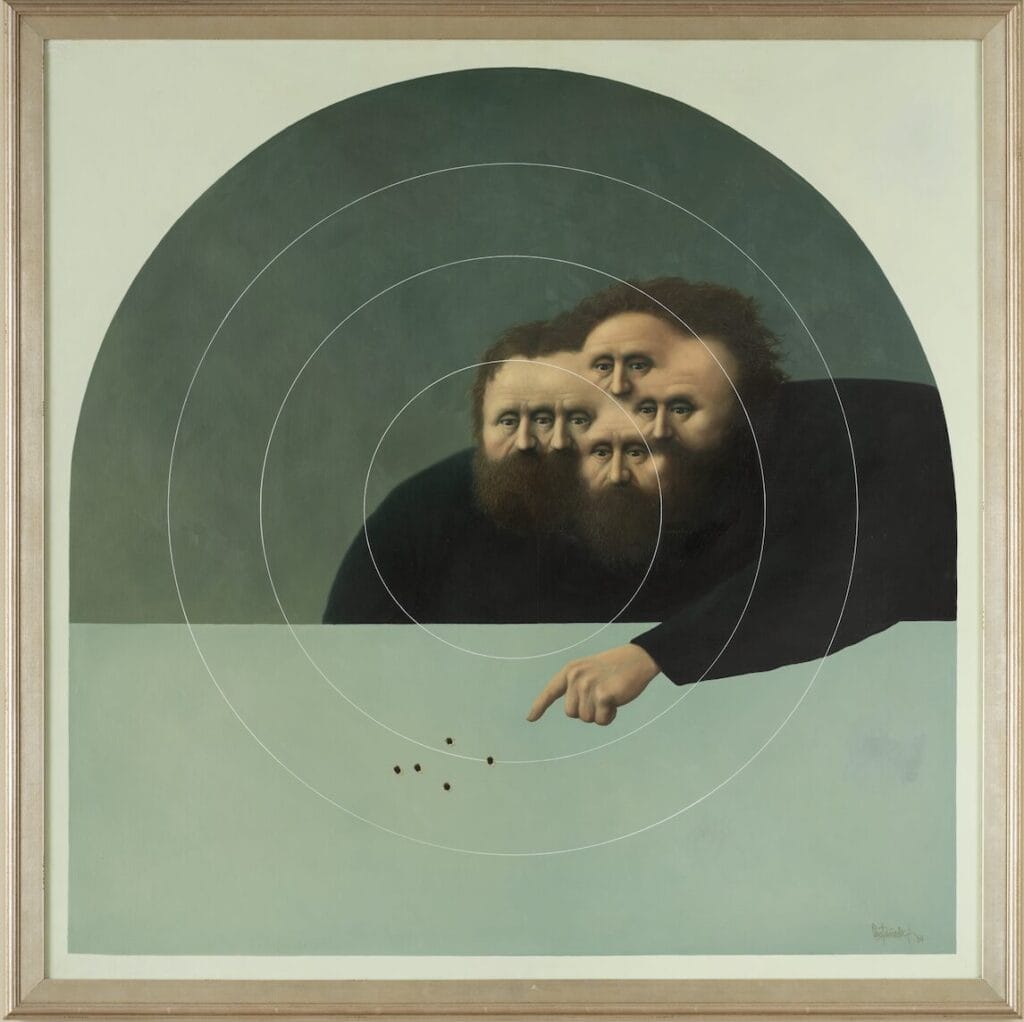
For example, in Here is the Center, 1984, we see five overlapping versions of the same face, a bearded man, who might represent a self-portrait of the artist, who is depicting his inner reality in paint. The amorphous figure points with one hand at five dots on a white surface. The dots turn out to be holes in the canvas and mirror the constellation of the five heads. The entire composition is enclosed inside a circle resembling a target. The question is: Where is the center? The painting argues that there is no single answer, as each self would designate a different point. In this, Castañeda masterfully visualizes the co-existence of multiple identities within a single being—a recurring and central theme in his work.”
Another recurring theme is the sea, symbolizing a threshold between known and unknown, a metaphor for transformation, and a vast interior landscape. In Hushed Music, from 2003, a band of five musicians— each with a noisy instrument like a drum, a tuba, a cymbal and a trumpet—are crammed into a stand that hovers in perfect stillness above a calm and endless sea. The contradiction between the loud instruments and the calm sea is striking. Is the vastness of the ocean swallowing the sound or at least dampening its volume? The musicians’ faces are all the same bearded man that greets us in almost every painting. They seem unperturbed by the isolation and cramped condition of their location. Noise is transformed into a hushed whisper.

Castañeda’s work is imbued with spirituality, which is reflected in religious symbols and gold surfaces reminiscent of sacred texts and illuminated manuscripts. But his relationship with religion was aesthetic, intellectual, and metaphorical, not devotional.
In Holy King from 2008, the frontal portrait of the bearded man reminds us of the strict symmetry of gothic religious art. The king’s face is embedded in a gold-leaved circle, which also serves as a crown or a halo, extending from his forehead to the edge of the inner circle inside a larger circle. A disembodied arm reaches from the edge of the canvas to his heart underneath a red robe. The religious symbolism is clear, but the message is mysterious. The image exudes restraint, silence and inwardness, and quiet reference.

In Memento for an Exile, the bearded man is floating in a bed on the vast ocean. Only his head sticks out from beneath the blanket. He looks expressionless at the viewer at the lower edge of the painting. In the center of the sea is a small image of an upside-down face. Neither the face nor the floating man are where they belong. They are exiled from their natural habitat. The big theme of exile in Castañeda’s work, does not only relate to physical exile, but also to the human condition of separation from others, from the self.

This theme of existential exile found a parallel in Castañeda’s own life. In 1990, at the age of 52, he chose a physical exile, relocating from Mexico to Madrid. He did not leave Mexico as a political refugee. He left because his daughters and her family lived there. He also felt a closer cultural affinityto the Spanish mystical and literary traditions that were the true sources of his art. With his wife Hortensia and children, he spent the rest of his life in Madrid because there he found the perfect context to continue his profound investigation into the ultimate exile—the exile of the human consciousness within the vast, unknowable universe of the self.
Castañeda was not an impoverished artist working in isolation in exile. He was successful and sold his work internationally. Prestigious galleries represented him, most notably the Mary-Anne Martin/Fine Art gallery in New York, which was a leading gallery for Latin American art and could demand respectable prices. He was also well educated in art history, as the painting Breakfast on the Grass (Le Petit Déjeuner sur l’herbe) from 2003 attests. It refers to the famous painting by Eduard Manet with the same name. In Manet’s painting two men and a nude woman have a picnic on the grass in the Bois de Boulogne in Paris. Unlike this social setting, Castañeda depicts a lone bearded man, sitting on the grass with his feet in a round water puddle, drinking a cup of coffee. Castañeda’s man does not need company. He is suspended in his own moment of self-reflection and contemplation.

In Waiting to Leave, from 2009, painted one year before his death, the bearded man sits on a beach, again with his feet in a round water puddle. He is waiting, or maybe just resting in an instant of life, in non-linear time, in which awareness emerges between waking and dreaming, memory and presence. The second panel of the painting depicts an empty boat, floating on the vast, glassy sea. This juxtaposition of images creates a form of visual poetry. It is hard not to draw a connection between the boat, ready to depart and this moment at the end of the artists’ life.
Walking through the exhibition, the viewer is drawn deeply into Castañeda’s poetic and surreal world—a world where time slows and suspends. These are frozen moments of meditation, where an awareness emerges of how precious and transient a single moment of life can be.