
by Cornelia Feye
May 28, 2024
Jasper Johns, Prints & Drawings, May 18-October 27
San Diego Museum of Art, Balboa Park
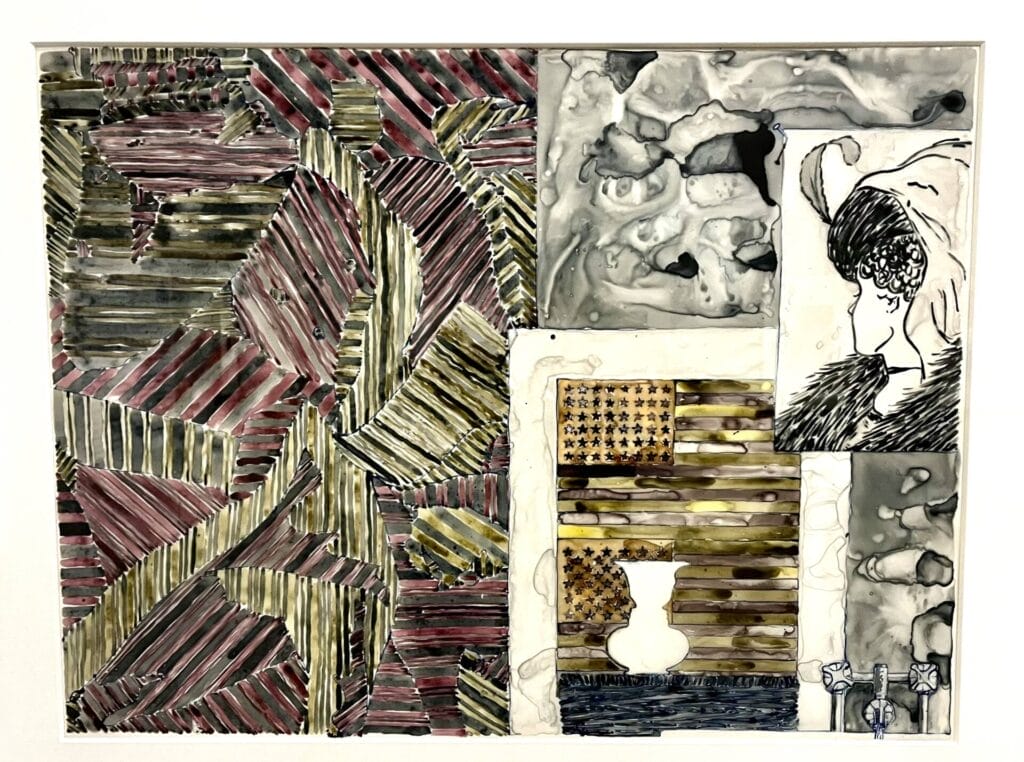
Since early in his career in the mid 1950s, Jasper Johns depicted familiar objects, “those that the mind already knows.” Familiar objects such as flags, beer cans, numbers, letters, bathroom fixtures, maps. But he also likes to draw and paint objects that trick the mind.
Now in his 90s, the acclaimed artist Jasper Johns had a long career, and the selective San Diego Museum of Art exhibition features works from 1960 until 2021. Out of the seven prints and seven drawings—most of them on loan from the artist, and two owned by the museum—Spring from 1986 and Untitled from 1983-84 features flip images that can be seen in two different ways: one shows a young woman with a elegant hat decorated with a rakish feather. Looked at another way, the same picture shows an old woman with a long, crooked nose wearing a kerchief over her head. Another optical illusion consists of a vase, or two profiles facing each other—Queen Elizabeth II and Prince Philip—depending on how you look at it. Or a duck, respectively a rabbit. Those images are fun to discover and flip back and forth in the viewer’s mind. They also show us how deceptive our perception can be. A painting or drawing is just lines, colors and shapes on paper, but the mind creates meaning, whether we want to or not.

For years, the museum’s print Green Angel, was considered just abstract, colored shapes with an intriguing title. The shapes could be mistaken for parts of a map. Again, the mind trying to make meaning. In 2021 the art critic John Yao pointed out the image was most likely based on a sculpture by Rodin of a minotaur carrying a woman’s body.
The pleasure of looking at John’s work is to find these decipherable and repeating images, like landmarks in the landscape. There are of course, the American flags, which Johns began painting in 1953-54 originally in encaustic. Several flag renditions in this exhibition deserve a second glance. The oldest work in the show from 1960, features two flags stacked on top of each other in graphite wash and graphite pencil. However, you have to stand directly in front of the drawing to recognize this most common of motives in Johns’ work, otherwise you may confuse it with plants or shrubbery.
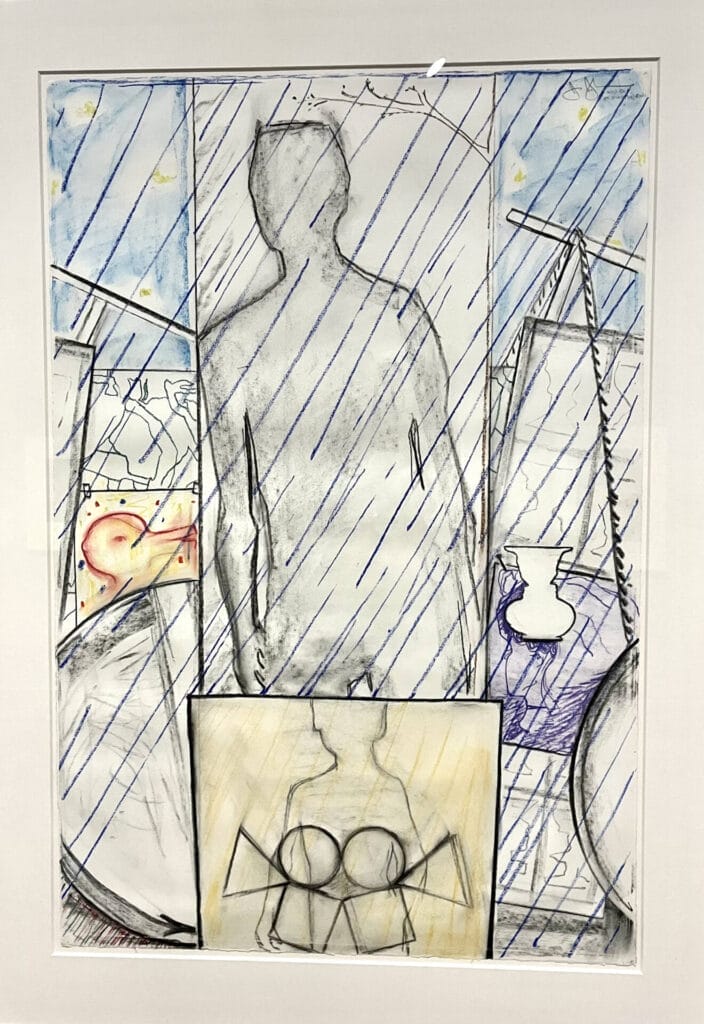
In the large print Spring— based on his paintings of the four seasons—two flags on top of each other make an appearance as well. This time they are recognizable, but the number of stars differs: one flag has 48, the other 50 stars, signifying the passage of time. Spring also includes a budding tree branch, rain and a silhouette of the artist.
Even though Johns mostly depicts common objects and abstractions, one drawing is based on the Picasso painting Woman in a Straw Hat with Blue Leaves. The motif is almost unchanged, but while the original is infused with strong colors, Johns depicted it in charcoal shades of gray and black and white.
Curator John Dijesere chose the displayed selection out of 890 works on paper the artist created since 1954. A crate was built to drive the prints across country from Connecticut, where the artist lives. Dijesere has been in contact with Johns since 1973 corresponding mostly per letter. He has curated two previous exhibitions of the artist’s work and has a deep knowledge and understanding of his printing and drawing techniques and processes.
The exhibition is concentrated in one gallery, but is definitely worth a visit, even if just to find the mind-tricking flip images, and let yourself be drawn into the visual world of one of the most influential and important American artists of the 20th century.